Thomas Jefferson
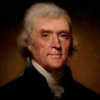
Thomas Jefferson
Thomas Jeffersonwas an American Founding Father who was the principal author of the Declaration of Independence. He was elected the second Vice President of the United States, serving under John Adams and in 1800 was elected the third President. Jefferson was a proponent of democracy, republicanism, and individual rights, which motivated American colonists to break from Great Britain and form a new nation. He produced formative documents and decisions at both the state and national level...
NationalityAmerican
ProfessionUS President
Date of Birth13 April 1743
CityShadwell, VA
CountryUnited States of America
Books may be classed from the Faculties of the mind
Well, Page, I do wish the Devil had old Cooke, for I am sure I never was so tired of an old dull scoundrel in my life ... But the old-fellows say we must read to gain knowledge; and gain knowledge to make us happy and be admired. Mere jargon! Is there any such thing as happiness in this world? No...
The Earth is given as a common for men to labor and live in.
A single good government is a blessing to the whole earth.
Never buy what you do not want, because it is cheap; it will be dear to you.
We prefer war in all cases to tribute under any form and to any people whatever.
If ever there was a holy war, it was that which saved our liberties and gave us independence.
The sentiments of men are known not only by what they receive, but what they reject also.
The only security of all is in a free press. The force of public opinion cannot be resisted when permitted freely to be expressed. The agitation it produces must be submitted to. It is necessary, to keep he waters pure.
[Emigrants] will bring with them the principles of the governments they leave, imbibed in their early youth; or, if able to throw off, it will be in exchange for an unbounded licentiousness, passing, as is usual, from one extreme to another. It would be a miracle were they to stop precisely at the point of temperate liberty.
I should . . . prefer swallowing one incomprehensibility rather than two. It requires one effort only to admit the single incomprehensibility of matter endowed with thought, and two to believe, first that of an existence called spirit, of which we have neither evidence nor idea, and then secondly how that spirit, which has neither extension nor solidity, can put material organs into motion.
That the enthusiasm which characterizes youth should lift its parricide hands against freedom and science would be such a monstrous phenomenon as I cannot place among possible things in this age and country.
Congress has not unlimited powers to provide for the general welfare, but only those specifically enumerated.
I have ever judged of the religion of others by their lives. For it is in our lives, and not from our works, that our religion must be read.