Thomas Jefferson
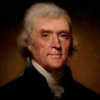
Thomas Jefferson
Thomas Jeffersonwas an American Founding Father who was the principal author of the Declaration of Independence. He was elected the second Vice President of the United States, serving under John Adams and in 1800 was elected the third President. Jefferson was a proponent of democracy, republicanism, and individual rights, which motivated American colonists to break from Great Britain and form a new nation. He produced formative documents and decisions at both the state and national level...
NationalityAmerican
ProfessionUS President
Date of Birth13 April 1743
CityShadwell, VA
CountryUnited States of America
Political interest [can] never be separated in the long run from moral right.
To every obstacle oppose patience, perseverance and soothing language.
A departure from principle in one instance becomes a precedent for a second; that second for a third; and so on, till the bulk of the society is reduced to be mere automatons of misery, to have no sensibilities left but for sin and suffering.
The selfish spirit of commerce, which knows no country, and feels no passion or principle but that of gain.
No nation is drunken where wine is cheap.
A lively and lasting sense of filial duty is more effectually impressed on the mind of a son or daughter by reading King Lear, than by all the dry volumes of ethics, and divinity that ever were written.
The happiest moments my heart knows are those in which it is pouring forth its affections to a few esteemed characters.
I find friendship to be like wine, raw when new, ripened with age, the true old man's milk and restorative cordial.
The moral sense, or conscience, is as much part of a man as his leg or arm. It is given to all in a stronger or weaker degree.. It may be strengthened by exercise.
But under the beaming, constant and almost vertical sun of Virginia, shade is our Elysium. In the absence of this no beauty of the eye can be enjoyed.
To make us one nation as to foreign concerns, and keep us distinct in Domestic ones gives the outline of the proper division of powers between the general [national] and particular [state] governments.
I set out on this ground which I suppose to be self-evident, that the earth belongs in usufruct to the living. . . . We seem not to perceive that, by the law of nature, one generation is to another as one independent nation is to another. . . . The earth belongs always to the living generations.
The Christian god is a being of terrific character - cruel, vindictive, capricious and unjust.
On the dogmas of religion, as distinguished from moral principles, all mankind, from the beginning of the world to this day, have been quarrelling, fighting, burning and torturing one another, for abstractions unintelligible to themselves and to all others, and absolutely beyond the comprehension of the human mind.