Walter Benjamin
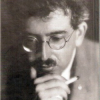
Walter Benjamin
Walter Bendix Schönflies Benjamin was a German Jewish philosopher and cultural critic. An eclectic thinker, combining elements of German idealism, Romanticism, Western Marxism, and Jewish mysticism, Benjamin made enduring and influential contributions to aesthetic theory, literary criticism, and historical materialism. He was associated with the Frankfurt School, and also maintained formative friendships with thinkers such as playwright Bertolt Brecht and Kabbalah scholar Gershom Scholem. He was also related by law to German political theorist Hannah Arendt through her first marriage...
NationalityGerman
ProfessionCritic
Date of Birth15 July 1892
CountryGermany
All great works of literature either dissolve a genre or invent one.
... [L]ess than at any time does a simple reproduction of reality tell us anything about reality. A photograph of the Krupp works or GEC yields almost nothing about those institutions. Reality proper has slipped into the functional. The reification of human relationships, the factory, let's say, no longer reveals these relationships. Therefore something has to be constructed, something artificial, something set up.
Quotations in my work are like wayside robbers who leap out armed and relieve the stroller of his conviction.
The illiterate of the future will not be the man who cannot read the alphabet, but the one who cannot take a photograph.
Boredom is the dream bird that hatches the egg of experience. A rustling in the leaves drives him away.
The art of storytelling is reaching its end because the epic side of truth, wisdom, is dying out.
Not to find one's way around a city does not mean much. But to lose one's way in a city, as one loses one's way in a forest, requires some schooling. Street names must speak to the urban wanderer like the snapping of dry twigs, and little streets in the heart of the city must reflect the times of day, for him, as clearly as a mountain valley. This art I acquired rather late in life; it fulfilled a dream, of which the first traces were labyrinths on the blotting papers in my school notebooks.
How many cities have revealed themselves to me in the marches I undertook in the pursuit of books!
I am unpacking my library. Yes I am. The books are not yet on the shelves, not yet touched by the mild boredom of order.
Any translation which intends to perform a transmitting function cannot transmit anything but information-hence, something inessential. This is the hallmark of bad translations.
Any order is a balancing act of extreme precariousness.
We have long forgotten the ritual by which the house of our life was erected. But when it is under assault and enemy bombs are already taking their toll, what enervated, perverse antiquities do they not lay bare in the foundations.
To do justice to the figure of Kafka in its purity and its peculiar beauty one must never lose sight of one thing: it is the purity and beauty of a failure.
The adjustment of reality to the masses and of the masses to reality is a process of unlimited scope, as much for thinking as for perception.