Walter Benjamin
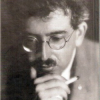
Walter Benjamin
Walter Bendix Schönflies Benjamin was a German Jewish philosopher and cultural critic. An eclectic thinker, combining elements of German idealism, Romanticism, Western Marxism, and Jewish mysticism, Benjamin made enduring and influential contributions to aesthetic theory, literary criticism, and historical materialism. He was associated with the Frankfurt School, and also maintained formative friendships with thinkers such as playwright Bertolt Brecht and Kabbalah scholar Gershom Scholem. He was also related by law to German political theorist Hannah Arendt through her first marriage...
NationalityGerman
ProfessionCritic
Date of Birth15 July 1892
CountryGermany
Like ultraviolet rays memory shows to each man in the book of life a script that invisibly and prophetically glosses the text.
If sleep is the apogee of physical relaxation, boredom is the apogee of mental relaxation. Boredom is the dream bird that hatches the egg of experience.
He who asks fortune-tellers the future unwittingly forfeits an inner intimation of coming events that is a thousand times more exact than anything they may say.
Things are only mannequins and even the great world-historical events are only costumes beneath which they exchange glances with nothingness
As Hegel put it, only when it is dark does the owl of Minerva begin its flight. Only in extinction is the collector comprehend.
In the fields with which we are concerned, knowledge comes only in flashes. The text is the thunder rolling long afterward.
You follow the same paths of thought as before. Only, they appear strewn with roses.
The present, which, as a model of Messianic time, comprises the entire history of mankind in an enormous abridgment, coincides with the stature which the history of mankind has in the universe.
Thinking involves not only the flow of thoughts, but their arrest as well.
Mechanical reproduction emancipates the work of art from its parasitical dependence on ritual.
I would like to metamorphose into a mouse-mountain.
To articulate the past historically does not mean to recognize it "the way it really was"...It means to seize hold of a memory as it flashes up at a moment of danger.
There is no muse of philosophy, nor is there one of translation.
Taking food alone tends to make one hard and coarse. Those accustomed to it must lead a Spartan life if they are not to go downhill. Hermits have observed, if for only this reason, a frugal diet. For it is only in company that eating is done justice; food must be divided and distributed if it is to be well received.