David Hume
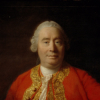
David Hume
David Hume– 25 August 1776) or David Homewas a Scottish philosopher, historian, economist, and essayist, who is best known today for his highly influential system of radical philosophical empiricism, skepticism, and naturalism...
NationalityScottish
ProfessionPhilosopher
Date of Birth7 May 1711
pain reflection thinking
The mention of one apartment in a building naturally introduces an enquiry or discourse concerning the others: and if we think ofa wound, we can scarcely forbear reflecting on the pain which follows it.
battle usual events
Battles, revolutions, pestilence, famine, and death, are never the effect of those natural causes, which we experience. Prodigies,omens, oracles, judgments, quite obscure the few natural events, that are intermingled with them. But as the former grow thinner every pagewe soon learn, that there is nothing mysterious or supernatural in the case, but that all proceeds from the usual propensity of mankind towards the marvellous, and that, though this inclination may at intervals receive a check from sense and learning, it can never be thoroughly extirpated.
men principles action
[The sceptic] must acknowledge, if he will acknowledge any thing, that all human life must perish, were his principles to prevail.All discourse, all action would immediately cease, and men remain in a total lethargy, till the necessities of nature, unsatisfied, put an end to their miserable existence.
employment occupation principles
The great subverter of Pyrrhonism or the excessive principles of scepticism is action, and employment, and the occupations of common life.
philosophy reflection common-sense
There is, indeed a more mitigated scepticism or academical philosophy, which may be both durable and useful, and which may, in part, be the result of this Pyrrhonism, or excessive scepticism, when its undistinguished doubts are corrected by common sense and reflection.
food poison virtue
Virtue, like wholesome food, is better than poisons, however corrected.
world littles ruins
It is not contrary to reason to prefer the destruction of the whole world to the scratching of my finger. It is not contrary to reason for me to choose my total ruin, to prevent the least uneasiness of an Indian, or person wholly unknown to me. It is as little contrary to reason to prefer even my own acknowledged lesser good to my greater, and have a more ardent affection for the former than the latter.
hurt army reflection
There is an universal tendency among mankind to conceive all beings like themselves, and to transfer to every object, those qualities, with which they are familiarly acquainted, and of which they are intimately conscious. We find human faces in the moon, armies in the clouds; and by a natural propensity, if not corrected by experience and reflection, ascribe malice or good-will to every thing, that hurts or pleases us.
veils arms opinion
[Rousseau] has not had the precaution to throw any veil over his sentiments; and as he scorns to dissemble his contempt of established opinions, he could not wonder that all the zealots were in arms against him.
air littles enthusiasm
Enthusiasm produces the most cruel disorders in human society; but its fury is like that of thunder and tempest, which exhaust themselves in a little time, and leave the air more calm and serene than before.
real men thinking
An infinite number of real parts of time, passing in succession, and exhausted one after another, appears so evident a contradiction, that no man, one should think, whose judgement is not corrupted, instead of being improved, by the sciences, would ever be able to admit of it.
mad followers influential
Rousseau was mad but influential; Hume was sane but had no followers.
philosophical discovery topics
THERE is no method of reasoning more common, and yet none more blameable, than, in philosophical disputes, to endeavour the refutation of any hypothesis, by a pretence of its dangerous consequences to religion and morality. When any opinion leads to absurdities, it is certainly false; but it is not certain that an opinion is false, because it is of dangerous consequence. Such topics, therefore, ought entirely to be forborne; as serving nothing to the discovery of truth, but only to make the person of an antagonist odious.
spring men luxury
All ills spring from some vice, either in ourselves or others; and even many of our diseases proceed from the same origin. Remove the vices; and the ills follow. You must only take care to remove all the vices. If you remove part, you may render the matter worse. By banishing vicious luxury, without curing sloth and an indifference to others, you only diminish industry in the state, and add nothing to men's charity or their generosity.