David Hume
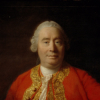
David Hume
David Hume– 25 August 1776) or David Homewas a Scottish philosopher, historian, economist, and essayist, who is best known today for his highly influential system of radical philosophical empiricism, skepticism, and naturalism...
NationalityScottish
ProfessionPhilosopher
Date of Birth7 May 1711
death philosophy lying
I shall venture to affirm, that there never was a popular religion, which represented the state of departed souls in such a light,as would render it eligible for human kind, that there should be such a state. These fine models of religion are the mere product of philosophy. For as death lies between the eye and the prospect of futurity, that event is so shocking to nature, that it must throw a gloom on all the regions which lie beyond it; and suggest to the generality of mankind the idea of Cerberus and Furies; devils, and torrents of fire and brimstone.
lying science reality
In all matters of opinion and science ... the difference between men is ... oftener found to lie in generals than in particulars; and to be less in reality than in appearance. An explication of the terms commonly ends the controversy, and the disputants are surprised to find that they had been quarrelling, while at bottom they agreed in their judgement.
running lying philosophy
All the sciences have a relation, greater or less, to human nature; and...however wide any of them may seem to run from it, they still return back by one passage or another. Even Mathematics, Natural Philosophy, and Natural Religion, are in some measure dependent on the science of MAN; since they lie under the cognizance of men, and are judged of by their powers and faculties.
lying moving reflection
Tis evident that all reasonings concerning matter of fact are founded on the relation of cause and effect, and that we can never infer the existence of one object from another, unless they be connected together, either mediately or immediately... Here is a billiard ball lying on the table, and another ball moving toward it with rapidity. They strike; and the ball which was formerly at rest now acquires a motion. This is as perfect an instance of the relation of cause and effect as any which we know, either by sensation or reflection.
god lying believe
When I think of God, when I think of him as existent, and when I believe him to be existent, my idea of him neither increases nordiminishes. But as it is certain there is a great difference betwixt the simple conception of the existence of an object, and the belief of it, and as this difference lies not in the parts or composition of the idea which we conceive; it follows, that it must lie in the manner in which we conceive it.
lying mind quality
All morality depends upon our sentiments; and when any action or quality of the mind pleases us after a certain manner we say it is virtuous; and when the neglect or nonperformance of it displeases us after a like manner, we say that we lie under an obligation to perform it.
lying order natural
Which is more likely: that the whole natural order is suspended, or that a jewish minx should tell a lie?
kindness liberty lost seldom
It is seldom that liberty of any kind is lost all at once.
arises bestow creature eminent human interests merit promote seems sentiment tendency
Upon the whole, then it seems undeniable, that nothing can bestow more merit on any human creature than the sentiment of benevolence in an eminent degree; and that a part at least of its merit arises from its tendency to promote the interests of our
character government law
How could politics be a science, if laws and forms of government had not a uniform influence upon society? Where would be the foundation of morals, if particular characters had no certain or determinate power to produce particular sentiments, and if these sentiments had no constant operation on actions?
beauty reflection mind
If the contemplation, even of inanimate beauty, is so delightful; if it ravishes the senses, even when the fair form is foreign tous: What must be the effects of moral beauty? And what influence must it have, when it embellishes our own mind, and is the result of our own reflection and industry?
doubt religion mystery
The whole [of religion] is a riddle, an ænigma, an inexplicable mystery. Doubt, uncertainty, suspence of judgment appear the onlyresult of our most accurate scrutiny, concerning this subject.
spring intelligent secret
Every disastrous accident alarms us, and sets us on enquiries concerning the principles whence it arose: Apprehensions spring up with regard to futurity: And the mind, sunk into diffidence, terror, and melancholy, has recourse to every method of appeasing those secret intelligent powers, on whom our fortune is supposed entirely to depend.
simple order religion
The whole of natural theologyresolves itself into one simple, though somewhat ambiguous proposition, That the cause or causesof order in the universe probably bear some remote analogy to human intelligence.