David Hume
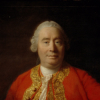
David Hume
David Hume– 25 August 1776) or David Homewas a Scottish philosopher, historian, economist, and essayist, who is best known today for his highly influential system of radical philosophical empiricism, skepticism, and naturalism...
NationalityScottish
ProfessionPhilosopher
Date of Birth7 May 1711
life death reflection
If we confine ourselves to a general and distant reflection on the ills of human life, that can have no effect to prepare us for them. If by close and intense meditation we render them present and intimate to us, that is the true secret for poisoning all our pleasures, and rendering us perpetually miserable.
philosophical men magic
Do you come to a philosopher as to a cunning man, to learn something by magic or witchcraft, beyond what can be known by common prudence and discretion?
philosophy philosophical views
The whole is a riddle, an enigma, an inexplicable mystery. Doubt, uncertainty, suspence of judgment appear the only result of ourmost accurate scrutiny, concerning this subject. But such is the frailty of human reason, and such the irresistible contagion of opinion, that even this deliberate doubt could scarcely be upheld; did we not enlarge our view, and opposing one species of superstition to another, set them a quarrelling; while we ourselves, during their fury and contention, happily make our escape into the calm, though obscure, regions of philosophy.
real philosophical regulation
Nothing can be more real, or concern us more, than our own sentiments of pleasure and uneasiness; and if these be favourable to virtue and unfavourable to vice, no more can be requisite to the regulation of our conduct and behavior.
philosophy philosophical men
The conduct of a man, who studies philosophy in this careless manner, is more truly sceptical than that of any one, who feeling inhimself an inclination to it, is yet so over-whelm'd with doubts and scruples, as totally to reject it. A true sceptic will be diffident of his philosophical doubts, as well as of his philosophical conviction; and will never refuse any innocent satisfaction, which offers itself, upon account of either of them.
truth ignorance numbers
To invent without scruple a new principle to every new phenomenon, instead of adapting it to the old; to overload our hypothesis with a variety of this kind, are certain proofs that none of these principles is the just one, and that we only desire, by a number of falsehoods, to cover our ignorance of the truth.
truth passion ideas
Reason, in a strict sense, as meaning the judgment of truth and falsehood, can never, of itself, be any motive to the will, and can have no influence but so far as it touches some passion or affection. Abstract relations of ideas are the object of curiosity, not of volition. And matters of fact, where they are neither good nor evil, where they neither excite desire nor aversion, are totally indifferent, and whether known or unknown, whether mistaken or rightly apprehended, cannot be regarded as any motive to action.
past events morality
It is still open for me, as well as you, to regulate my behavior, by my experience of past events.
intelligent perception-of-beauty judgement
There has been a controversy started of late, much better worth examination, concerning the general foundation of Morals; whether they be derived from Reason, or from Sentiment; whether we attain the knowledge of them by a chain of argument and induction, or by an immediate feeling and finer internal sense; whether, like all sound judgement of truth and falsehood, they should be the same to every rational intelligent being; or whether, like the perception of beauty and deformity, they be founded entirely on the particular fabric and constitution of the human species.
passion men giving
Truth is disputable; not taste: what exists in the nature of things is the standard of our judgement; what each man feels within himself is the standard of sentiment. Propositions in geometry may be proved, systems in physics may be controverted; but the harmony of verse, the tenderness of passion, the brilliancy of wit, must give immediate pleasure. No man reasons concerning another's beauty; but frequently concerning the justice or injustice of his actions.
ties may belief
Disbelief in futurity loosens in a great measure the ties of morality, and may be for that reason pernicious to the peace of civil society.
pain light hatred
For my part, when I enter most intimately into what I call myself, I always stumble on some particular perception or other, of heat or cold, light or shade, love or hatred, pain or pleasure. I never can catch myself at any time without a perception, and never can observe anything but the perception.
mind perception philosopher
The mind is a kind of theater, where several perceptions successively make their appearence; pass, re-pass, glide away, and mingle in an infinite variety of postures and situations.
gains applause harder
It is harder to avoid censure than to gain applause.