Erwin Schrodinger
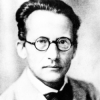
Erwin Schrodinger
Erwin Rudolf Josef Alexander Schrödinger, sometimes written as Erwin Schrodinger or Erwin Schroedinger, was a Nobel Prize-winning Austrian physicist who developed a number of fundamental results in the field of quantum theory, which formed the basis of wave mechanics: he formulated the wave equationand revealed the identity of his development of the formalism and matrix mechanics. Schrödinger proposed an original interpretation of the physical meaning of the wave function...
NationalityAustrian
ProfessionScientist
Date of Birth12 August 1887
CityVienna, Austria
CountryAustria
Matter and energy seem granular in structure, and so does “life”, but not so mind.
In this communication I wish first to show in the simplest case of the hydrogen atom (nonrelativistic and undistorted) that the usual rates for quantization can be replaced by another requirement, in which mention of "whole numbers" no longer occurs. Instead the integers occur in the same natural way as the integers specifying the number of nodes in a vibrating string. The new conception can be generalized, and I believe it touches the deepest meaning of the quantum rules.
It seems plain and self-evident, yet it needs to be said: the isolated knowledge obtained by a group of specialists in a narrow field has in itself no value whatsoever, but only in its synthesis with all the rest of knowledge and only inasmuch as it really contributes in this synthesis toward answering the demand, "Who are we?
If all this damned quantum jumping were really here to stay, I should be sorry, I should be sorry I ever got involved with quantum theory.
The stages of human development are to strive for:(1) Besitz [Possession](2) Wissen [Knowledge](3) Können [Ability](4) Sein [Being
The mathematical framework of quantum theory has passed countless successful tests and is now universally accepted as a consistent and accurate description of all atomic phenomena.
In Darwin's theory, you just have to substitute 'mutations' for his 'slight accidental variations' (just as quantum theory substitutes 'quantum jump' for 'continuous transfer of energy'). In all other respects little change was necessary in Darwin's theory...
The sensation of colour cannot be accounted for by the physicist's objective picture of light-waves.
The world is given to me only once, not one existing and one perceived. Subject and object are only one. The barrier between them cannot be said to have broken down as a result of recent experience in the physical sciences, for this barrier does not exist.
Thus you can throw yourself flat on the ground, stretched out upon Mother Earth, with the certain conviction that you are one with her and she with you. You are as firmly established, as invulnerable as she, indeed a thousand times firmer and more invulnerable. As surely as she will engulf you tomorrow, so surely will she bring you forth anew to the new striving and suffering. And not merely "some day." Now, today, every day she is bringing you forth, not once but thousands upon thousands of times, just as every day she engulfs you a thousand times over.
I belong to those theoreticians who know by direct observation what it means to make a measurement. Methinks it were better if there were more of them.
The world is a construct of our sensations, perceptions, memories. It is convenient to regard it as existing objectively on its own. But it certainly does not become manifest by its mere existence.
The self is not so much linked to its ancestors, it is not so much the product, and merely the product, of all that, but rather, in the strictest sense of the word, the same thing as all that: the strict, direct continuation of it, just as the self aged fifty is the continuation of the self aged forty.
Whence come I and whither go I? That is the great unfathomable question. Science has no answer to it.