Erwin Schrodinger
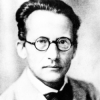
Erwin Schrodinger
Erwin Rudolf Josef Alexander Schrödinger, sometimes written as Erwin Schrodinger or Erwin Schroedinger, was a Nobel Prize-winning Austrian physicist who developed a number of fundamental results in the field of quantum theory, which formed the basis of wave mechanics: he formulated the wave equationand revealed the identity of his development of the formalism and matrix mechanics. Schrödinger proposed an original interpretation of the physical meaning of the wave function...
NationalityAustrian
ProfessionScientist
Date of Birth12 August 1887
CityVienna, Austria
CountryAustria
No self is of itself alone
The material world has only been constructed at the price of taking the self, that is, mind, out of it, removing it; mind is not part of it...
No self is of itself alone. It has a long chain of intellectual ancestors. The 'I' is chained to ancestry by many factors... This is not mere allegory, but an eternal memory.
Vedanta teaches that consciousness is singular, all happenings are played out in one universal consciousness and there is no multiplicity of selves The stages of human development are to strive for Possession (Artha), Knowledge (Dharma), Ability (Kama), Being (Moksha) Nirvana is a state of pure blissful knowledge. It has nothing to do with individual. The ego or its separation is an illusion. The goal of man is to preserve his Karma and to develop it further – when man dies his karma lives and creates for itself another carrier.
Our perceiving self is nowhere to be found in the world-picture, because it itself is the world-picture.
It seems plain and self-evident, yet it needs to be said: the isolated knowledge obtained by a group of specialists in a narrow field has in itself no value whatsoever, but only in its synthesis with all the rest of knowledge and only inasmuch as it really contributes in this synthesis toward answering the demand, "Who are we?
The self is not so much linked to its ancestors, it is not so much the product, and merely the product, of all that, but rather, in the strictest sense of the word, the same thing as all that: the strict, direct continuation of it, just as the self aged fifty is the continuation of the self aged forty.
I don't like it, and I'm sorry I ever had anything to do with it.
Consciousness is never experienced in the plural, only in the singular. Not only has none of us ever experienced more than one consciousness, but there is also no trace of circumstantial evidence of this ever happening anywhere in the world. If I say that there cannot be more than one consciousness in the same mind, this seems a blunt tautology - we are quite unable to imagine the contrary...
This life of yours which you are living is not merely a piece of this entire existence, but in a certain sense the whole; only this whole is not so constituted that it can be surveyed in one single glance. This, as we know, is what the Brahmins [wise men or priests in the Vedic tradition] express in that sacred, mystic formula which is yet really so simple and so clear; tat tvam asi, this is you. Or, again, in such words as “I am in the east and the west, I am above and below, I am this entire world.
Entanglement is not one but rather the characteristic trait of quantum mechanics.
If a man never contradicts himself, the reason must be that he virtually never says anything at all.
The verbal interpretation, on the other hand, i.e. the metaphysics of quantum physics, is on far less solid ground. In fact, in more than forty years physicists have not been able to provide a clear metaphysical model.
[Plato] was the first to envisage the idea of timeless existence and to emphasize it-against reason-as a reality, more [real] than our actual experience...