Erwin Schrodinger
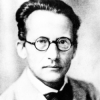
Erwin Schrodinger
Erwin Rudolf Josef Alexander Schrödinger, sometimes written as Erwin Schrodinger or Erwin Schroedinger, was a Nobel Prize-winning Austrian physicist who developed a number of fundamental results in the field of quantum theory, which formed the basis of wave mechanics: he formulated the wave equationand revealed the identity of his development of the formalism and matrix mechanics. Schrödinger proposed an original interpretation of the physical meaning of the wave function...
NationalityAustrian
ProfessionScientist
Date of Birth12 August 1887
CityVienna, Austria
CountryAustria
There is no kind of framework within which we can find consciousness in the plural; this is simply something we construct because of the temporal plurality of individuals, but it is a false construction The only solution to this conflict insofar as any is available to us at all lies in the ancient wisdom of the Upanishad.
Quantum physics thus reveals a basic oneness of the universe.
Multiplicity is only apparent, in truth, there is only one mind...
The verbal interpretation, on the other hand, i.e. the metaphysics of quantum physics, is on far less solid ground. In fact, in more than forty years physicists have not been able to provide a clear metaphysical model.
The great revelation of the quantum theory was that features of discreteness were discovered in the Book of Nature, in a context in which anything other than continuity seemed to be absurd according to the views held until then.
An animal that embarks on forming states without greatly restricting egoism will perish.
Our mind, by virtue of a certain finite, limited capability, is by no means capable of putting a question to Nature that permits a continuous series of answers. The observations, the individual results of measurements, are the answers of Nature to our discontinuous questioning.
From all we have learnt about the structure of living matter, we must be prepared to find it working in a manner that cannot be reduced to the ordinary laws of physics. And that not on the ground that there is any "new force" or what not, directing the behavior of the single atoms within a living organism, but because the construction is different from anything we have yet tested in the physical laboratory.
For a solitary animal egoism is a virtue that tends to preserve and improve the species: in any kind of community it becomes a destructive vice.
The plurality that we perceive is only an appearance; it is not real. Vedantic philosophy... has sought to clarify it by a number of analogies, one of the most attractive being the many-faceted crystal which, while showing hundreds of little pictures of what is in reality a single existent object, does not really multiply that object...
If we are going t stick to this damned quantum-jumping, then I regret that I ever had anything to do with quantum theory.