Nhat Hanh
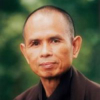
Nhat Hanh
Thích Nhất Hạnh; born as Nguyen Xuan Bao on October 11, 1926) is a Vietnamese Buddhist monk and peace activist. He lives in Plum Village in the Dordogne region in the south of France, travelling internationally to give retreats and talks. He coined the term "Engaged Buddhism" in his book Vietnam: Lotus in a Sea of Fire. A long-term exile, he was given permission to make his first return trip to Vietnam in 2005...
NationalityVietnamese
ProfessionActivist
Date of Birth11 October 1926
CountryVietnam
One day I saw a picture of the Buddha on a Buddhist magazine and he was sitting on the grass, and he was sitting on the grass, very peaceful, smiling, and I was impressed. Around me people were not like that, so I had the desire to be someone like him. I nourished that kind of desire until the age of sixteen, when I had the permission from my parents to go and ordain as a Buddhist monk.
We talk about social service, service to the people, service to humanity, service to others who are far away, helping to bring peace to the world - but often we forget that it is the very people around us that we must live for first of all. If you cannot serve your wife or husband or child or parent - how are you going to serve society? If you cannot make your own child happy, how do you expect to be able to make anyone else happy? If all our friends in the peace movement or of service communities of any kind do not love and help each other, whom can we love and help?
Anyone can practice some nonviolence, even soldiers. Some army generals, for example, conduct their operations in ways that avoid killing innocent people; this is a kind of nonviolence.
If we can not smile, we cannot help other people to smile.
Buddhism has to do with your daily life, with your suffering and with the suffering of the people around you.
Without being peace, we cannot do anything for peace. If we cannot smile, we cannot help other people to smile. If we are not peaceful, then we cannot contribute to the peace movement.
Maybe we have enough technology to save the planet but it is not enough because the people are not ready.
Without collective awakening the catastrophe will come. I think people in the mass media, journalists, film makers and others, you can contribute to the collective awakening if you are awake and then your life will embody that awakening.
The Buddha also counseled the monks and nuns to avoid wasting any precious time by engaging in idle conversation, oversleeping, pursuing fame and recognition, chasing after desires, spending time with people of poor character, and being satisfied with only a shallow understanding of the teaching.
To educate people for peace, we can use words or we can speak with our lives.
Love doesn't have any color. Other people may discriminate against us, but what is more important is whether we discriminate against them. If we don't do that, we are a happier person, and as a happier person, we are in a position to help. And anger, this is not a help.
But if we have the energy of compassion and loving kindness in us, the people around us will be influenced by our way of being and living.
A bodhisattva doesn't have to be perfect. Anyone who is aware of what is happening and who tries to wake up other people is a bodhisattva. We are all bodhisattvas, doing our best.
To reconcile conflicting parties, we must have the ability to understand the suffering of both sides. If we take sides, it is impossible to do the work of reconciliation. And humans want to take sides. That is why the situation gets worse and worse. Are there people who are still available to both sides? They need not do much. They need do only one thing: Go to one side and tell all about the suffering endured by the other side, and go to the other side and tell all about the suffering endured by this side. This is our chance for peace. But how many of us are able to do that?