Philip Guston
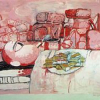
Philip Guston
Philip Guston, born Phillip Goldstein, was a painter and printmaker in the New York School, which included many of the abstract expressionists, such as Jackson Pollock and Willem de Kooning. In the late 1960s Guston helped to lead a transition from abstract expressionism to neo-expressionism in painting, abandoning the so-called "pure abstraction" of abstract expressionism in favor of more cartoonish renderings of various personal symbols and objects...
NationalityAmerican
ProfessionPainter
Date of Birth27 June 1913
CountryUnited States of America
We are image-makers and image-ridden... We work until we vanish.
To will a new form is unacceptable, because will builds distortion. Desire, too, is incomplete and arbitrary. These strategies, however intimate they might become, must especially be removed to clear the way for something else...
Look at any inspired painting. It's like a gong sounding; it puts you in a state of reverberation.
You know, comments about style always seem strange to me - 'why do you work in this style, or in that style' - as if you had a choice in the matter... What you're doing is trying to stay alive and continue and not die.
Then you learn about composition, you learn about old masters, you form certain ideas about structure. But the inhuman activity of trying to make some kind of jump or leap, where , the painting is always saying, 'What do you want from me? I can only be a painting.' You have to go from part to part, but you shouldn't see yourself go from part to part, that's the whole point.
There's some mysterious process at work here, which I don't even want to understand.
Painting seems like some kind of peculiar miracle that I need to have again and again.
I have a studio in the country - in the woods - but my paintings look more real to me than what is outdoors. You walk outside; the rocks are inert; even the clouds are inert. It makes me feel a little better. But I do have a faith that it is possible to make a living thing, not a diagram of what I have been thinking: to posit with paint something living, something that changes each day.
Painting and sculpture are very archaic forms. It's the only thing left in our industrial society where an individual alone can make something with not just his own hands, but brains, imagination, heart maybe.
Painting is an illusion, a piece of magic, so what you see is not what you see. I don't know what a painting is; who knows what sets off even the desire to paint? It might be things, thoughts, a memory, sensations, which have nothing to do directly with painting itself. They can come from anything and anywhere.
Studio Ghosts: When you're in the studio painting, there are a lot of people in there with you - your teachers, friends, painters from history, critics... and one by one if you're really painting, they walk out. And if you're really painting YOU walk out.
Painting is an illusion, a piece of magic, so what you see is not what you see.
I don't know what a painting is; who knows what sets off even the desire to paint? It might be things, thoughts, a memory, sensations, which have nothing to do directly with painting itself. They can come from anything and anywhere.
But you begin to feel as you go on working that unless painting proves its right to exist by being critical and self-judging, it has no reason to exist at all - or is not even possible. The canvas is a court where the artist is prosecutor, defendant, jury and judge. Art without a trial disappears at a glance.