Philip Guston
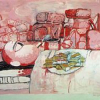
Philip Guston
Philip Guston, born Phillip Goldstein, was a painter and printmaker in the New York School, which included many of the abstract expressionists, such as Jackson Pollock and Willem de Kooning. In the late 1960s Guston helped to lead a transition from abstract expressionism to neo-expressionism in painting, abandoning the so-called "pure abstraction" of abstract expressionism in favor of more cartoonish renderings of various personal symbols and objects...
NationalityAmerican
ProfessionPainter
Date of Birth27 June 1913
CountryUnited States of America
The canvas is a court where the artist is prosecutor, defendant, jury and judge. Art without a trial disappears at a glance.
All these troubles revolve around the irritable mutual dependence of life and art - with their need and contempt for one another. Of necessity, to create is a temporary state and cannot be possessed...
Lots of artists who paint have the experience to one degree or another... where their thinking doesn't precede their doing... It's a funny thing, what I really hate yet I have to go through with it, is the preparation.
Probably the most potent desire for a painter, an image-maker, is to see it. To see what the mind can think and imagine, to realize it for oneself, through oneself, as concretely as possible.
Painting seems like impossibility, with only a sign now and then of its own light.
It is possible to make a living thing, not a diagram of what I have been thinking: to posit with paint something living, something that changes each day.
There comes a point when the paint doesn't feel like paint. I don't know why. Some mysterious thing happens. I think you have all experienced it... What counts is that the paint should really disappear, otherwise it's craft.
That's what I mean by something grips in a canvas. The moment that happens you are then sucked into the whole thing. Like some kind of rhythm.
Usually I draw in relation to my painting, what I am working on at the time. On a lucky day a surprising balance of forms and spaces will appear... making itself, the image taking hold. This in turn moves me toward painting - anxious to get to the same place, with the actuality of paint and light.
Many works of the past complete what they announce they are going to do, to our increasing boredom. Certain others plague me because I cannot follow their intentions. I can tell at a glance what Fabritius is doing, but I am spending my life trying to find out what Rembrandt was up to.
Frustration is one of the great things in art. Satisfaction is nothing.
When I see people making 'abstract' painting, I think it's just a dialogue and a dialogue isn't enough. That is to say, there is you painting and this canvas. I think there has to be a third thing; it has to be a trialogue.
Sometimes I scrape off a lot. You have on the floor, like cow dung in the field, this big glob of paint... and it's just a lot of inert matter, inert paint. Then I look back at the canvas, and it's not inert - it's active, moving and living.
Where do you put a form? It will move all around, bellow out and shrink, and sometimes it winds up where it was in the first place. But at the end it feels different, and it had to make the voyage. I am a moralist and cannot accept what has not been paid for, or a form that has not been lived through.