Philip Guston
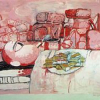
Philip Guston
Philip Guston, born Phillip Goldstein, was a painter and printmaker in the New York School, which included many of the abstract expressionists, such as Jackson Pollock and Willem de Kooning. In the late 1960s Guston helped to lead a transition from abstract expressionism to neo-expressionism in painting, abandoning the so-called "pure abstraction" of abstract expressionism in favor of more cartoonish renderings of various personal symbols and objects...
NationalityAmerican
ProfessionPainter
Date of Birth27 June 1913
CountryUnited States of America
There is something mysterious in this work that I do not ever what to discover.
There's some mysterious process at work here, which I don't even want to understand.
There comes a point when the paint doesn't feel like paint. I don't know why. Some mysterious thing happens. I think you have all experienced it... What counts is that the paint should really disappear, otherwise it's craft.
The canvas you are working on modifies the previous ones in an unending, baffling chain which never seems to finish. What sympathy is demanded of the viewer? He is asked to 'see' the future links.
I'm not interested in painting; I'm not interested in making a picture. Then what the hell am I interested in? I must be interested in this process.
More than a process, painting is being possessed...
In my experience a painting is not made with colors and paint at all. I don't know what a painting is; who knows what sets off even the desire to paint?
It is the bareness of drawing that I like. The act of drawing is what locates, suggests, discovers. At times it seems enough to draw, without the distractions of color and mass. Yet it is an old ambition to make drawing and painting one.
If the artist starts evaluating himself, it’s an enormous block, isn’t it?
I do not see why the loss of faith in the known image and symbol in our time should be celebrated as a freedom. It is a loss from which we suffer, and this pathos motivates modern painting and poetry at its heart.
I feel more as if I'm shaping something with my hands. I feel as if I've always wanted to get to that state. Like a blind man in a dark room had some clay, what would he make? I end up with 2 or 3 forms on a canvas, but it gets very physical for me.
To paint is a possessing rather than a picturing.
I am a night painter, so when I come into the studio the next morning the delirium is over.
What is seen and called the picture is what remains - an evidence. Even as one travels in painting toward a state of 'unfreedom' where only certain things can happen, unaccountably the unknown and free must appear.