Philip Guston
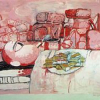
Philip Guston
Philip Guston, born Phillip Goldstein, was a painter and printmaker in the New York School, which included many of the abstract expressionists, such as Jackson Pollock and Willem de Kooning. In the late 1960s Guston helped to lead a transition from abstract expressionism to neo-expressionism in painting, abandoning the so-called "pure abstraction" of abstract expressionism in favor of more cartoonish renderings of various personal symbols and objects...
NationalityAmerican
ProfessionPainter
Date of Birth27 June 1913
CountryUnited States of America
The things I felt... about certain painters of the past that... inspired me, like Cezanne and Manet... that complete losing of oneself in the work to such an extent that the work itself... felt as if a living organism was posited there on the canvas, on this surface... That's truly... the act of creation.
The painting is not on a surface, but on a plane which is imagined. It moves in a mind. It is not there physically at all. It is an illusion, a piece of magic, so that what you see is not what you see.
Do I really believe that? I make a mark, a few strokes, I argue with myself, not do I like or not, but is it true or not? Is that what I mean, is that what I want?
Usually I am on a work for a long stretch, until a moment arrives when the air of the arbitrary vanishes, and the paint falls into positions that feel destined.
I should like to paint like an man who has never seen a painting, but this man -myself - lives in a museum.
No good to paint in the head - what happens is what happens when you put the paint down - you can only hope that you are alert - ready - to see. What joy it is for paint to become a thing - a being. Believe in this miracle - it is your only hope. To will this transformation is not possible. Only a slow maturation can prepare the hand and eye to become quicker than ever. Ideas about art don't matter. They collapse anyway in front of the painting.
There are so many things in the world - in the cities - so much to see. Does art need to represent this variety and contribute to its proliferation? Can art be that free? The difficulties begin when you understand what it is that the soul will not permit the hand to make.