Samuel Johnson
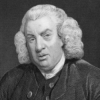
Samuel Johnson
Samuel Johnson, often referred to as Dr Johnson, was an English writer who made lasting contributions to English literature as a poet, essayist, moralist, literary critic, biographer, editor and lexicographer. Johnson was a devout Anglican and committed Tory, and has been described as "arguably the most distinguished man of letters in English history". He is also the subject of "the most famous single biographical work in the whole of literature," James Boswell's Life of Samuel Johnson...
NationalityEnglish
ProfessionNon-Fiction Author
Date of Birth18 September 1709
Among the numerous requisites that must concur to complete an author, few are of more importance than an early entrance into the living world. The seed of knowledge may be planted in solitude, but must be cultivated in public. Argumentation may be taught in colleges, and theories formed in retirement; but the artifice of embellishment and the powers of attraction can be gained only by a general converse.
In writing, as in life, faults are endured without disgust when they are associated with transcendent merit, and may be sometimes recommended to weak judgments by the lustre which they obtain from their union with excellence; but it is the business of those who presume to superintend the taste or morals of mankind to separate delusive combinations, and distinguish that which may be praised from that which can only be excused.
It ought to be the first endeavour of a writer to distinguish nature from custom; or that which is established because it is right, from that which is right only because it is established; that he may neither violate essential principles by a desire of novelty, nor debar himself from the attainment of beauties within his view, by a needless fear of breaking rules which no literary dictator had authority to enact.
As every writer has his use, every writer ought to have his patrons; and since no man, however high he may now stand, can be certain that he shall not be soon thrown down from his elevation by criticism or caprice, the common interest of learning requires that her sons should cease from intestine hostilities, and, instead of sacrificing each other to malice and contempt, endeavour to avert persecution from the meanest of their fraternity.
Those authors who would find many readers, must endeavour to please while they instruct.
There is ... scarcely any species of writing of which we can tell what is its essence, and what are its constituents; every new genius produces some innovation, which, when invented and approved, subverts the rules which the practice of foregoing authors had established.
There are, indeed, few kinds of composition from which an author, however learned or ingenious, can hope a long continuance of fame.
No place affords a more striking conviction of the vanity of human hopes than a public library; for who can see the wall crowded on every side by mighty volumes, the works of laborious meditations and accurate inquiry, now scarcely known but by the catalogue...
Many causes may vitiate a writer's judgement of his own works. On that which has cost him much labour he sets a high value, because he is unwilling to think that he has been diligent in vain: what has been produced without toilsome efforts is considered with delight as a proof of vigorous faculties and fertile invention; and the last work, whatever it be, has necessarily most of the grace of novelty.
Invention is almost the only literary labour which blindness cannot obstruct.
He that writes may be considered as a kind of general challenger, whom every one has a right to attack; since he quits the common rank of life, steps forward beyond the lists, and offers his merit to the public judgement. To commence author is to claim praise, and no man can justly aspire to honour, but at the hazard of disgrace.
Too much nicety of detail disgusts the greatest part of readers, and to throw a multitude of particulars under general heads, and lay down rules of extensive comprehension, is to common understandings of little use.
There seems to be a strange affectation in authors of appearing to have done everything by chance.
The art of the writer, like that of the player, is attained by slow degrees. The power of distinguishing and discriminating comick characters, or of filling tragedy with poetical images, must be the gift of nature, which no instruction nor labour can supply; but the art of dramatick disposition, the contexture of the scenes, the involution of the plot, the expedients of suspension, and the strategems of surprise, are to be learned by practice.