Samuel Johnson
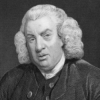
Samuel Johnson
Samuel Johnson, often referred to as Dr Johnson, was an English writer who made lasting contributions to English literature as a poet, essayist, moralist, literary critic, biographer, editor and lexicographer. Johnson was a devout Anglican and committed Tory, and has been described as "arguably the most distinguished man of letters in English history". He is also the subject of "the most famous single biographical work in the whole of literature," James Boswell's Life of Samuel Johnson...
NationalityEnglish
ProfessionNon-Fiction Author
Date of Birth18 September 1709
In this work are exhibited, in a very high degree, the two most engaging powers of an author. New things are made familiar, and familiar things are made new.
It is indeed not easy to distinguish affectation from habit; he that has once studiously developed a style, rarely writes afterwards with complete ease.
Every man is of importance to himself, and, therefore, in his own opinion, to others; and, supposing the world already acquainted with his pleasures and his pains, is perhaps the first to publish injuries or misfortunes which had never been known unless related by himself, and at which those that hear them will only laugh, for no man sympathises with the sorrows of vanity.
Works of imagination excel by their allurement and delight; by their power of attracting and detaining the attention. That book is good in vain which the reader throws away. He only is the master who keeps the mind in pleasing captivity; whose pages are perused with eagerness, and in hope of new pleasure are perused again; and whose conclusion is perceived with an eye of sorrow, such as the traveller casts upon departing day.
Allegories drawn to great length will always break.
New arts are long in the world before poets describe them; for they borrow everything from their predecessors, and commonly derive very little from nature or from life.
Words too familiar, or too remote, defeat the purpose of a poet. From those sounds which we hear on small or on coarse occasions, we do not easily receive strong impressions, or delightful images; and words to which we are nearly strangers, whenever they occur, draw that attention on themselves which they should transmit to other things.
He who writes much will not easily escape a manner, such a recurrence of particular modes as may be easily noted.
A writer who obtains his full purpose loses himself in his own lustre.
I look upon this as I did upon the Dictionary: it is all work, and my inducement to it is not love or desire of fame, but the want of money, which is the only motive to writing that I know of.
Consultation and compliance can conduce little to the perfection of any literary performance; for whoever is so doubtful of his own abilities as to encourage the remarks of others, will find himself every day embarrassed with new difficulties, and will harass his mind, in vain, with the hopeless labour of uniting heterogeneous ideas, digesting independent hints, and collecting into one point the several rays of borrowed light, emitted often with contrary directions.
A successful author is equally in danger of the diminution of his fame, whether he continues or ceases to write. The regard of the public is not to be kept but by tribute, and the remembrance of past service will quickly languish unless successive performances frequently revive it. Yet in every new attempt there is new hazard, and there are few who do not, at some unlucky time, injure their own characters by attempting to enlarge them.
It is much easier not to write like a man than to write like a woman.
It is the condition of our present state to see more than we can attain; the exactest vigilance and caution can never maintain a single day of unmingled innocence... It is, however, necessary for the idea of perfection to be proposed, that we may have some object to which our endeavours are to be directed; and he that is most deficient in the duties of life makes some atonement for his faults if he warns others against his own failings, and hinders, by the salubrity of his admonitions, the contagion of his example.