Samuel Johnson
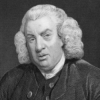
Samuel Johnson
Samuel Johnson, often referred to as Dr Johnson, was an English writer who made lasting contributions to English literature as a poet, essayist, moralist, literary critic, biographer, editor and lexicographer. Johnson was a devout Anglican and committed Tory, and has been described as "arguably the most distinguished man of letters in English history". He is also the subject of "the most famous single biographical work in the whole of literature," James Boswell's Life of Samuel Johnson...
NationalityEnglish
ProfessionNon-Fiction Author
Date of Birth18 September 1709
It is not difficult to conceive, however, that for many reasons a man writes much better than he lives. For without entering into refined speculations, it may be shown much easier to design than to perform. A man proposes his schemes of life in a state of abstraction and disengagement, exempt from the enticements of hope, the solicitations of affection, the importunities of appetite, or the depressions of fear.
Among the many inconsistencies which folly produces or infirmity suffers in the human mind, there has often been observed a manifest and striking contrariety between the life of an author and his writings... Those whom the appearance of virtue or the evidence of genius has tempted to a nearer knowledge of the writer, in whose performances they may be found, have indeed had frequent reason to repent their curiosity.
It is justly considered as the greatest excellency of art to imitate nature; but it is necessary to distinguish those parts of nature which are most proper for imitation: greater care is still required in representing life, which is so often discoloured by passion or deformed by wickedness. If the world be promiscuously described, I cannot see of what use it can be to read the account; or why it may not be as safe to turn the eye immediately upon mankind, as upon a mirror which shows all that presents itself without discrimination.
The task of an author is, either to teach what is not known, or to recommend known truths by his manner of adorning them; either to let new light in upon the mind, and open new scenes to the prospect, or to vary the dress and situation of common objects, so as to give them fresh grace and more powerful attractions, to spread such flowers over the regions through which the intellect has already made its progress, as may tempt it to return, and take a second view of things hastily passed over, or negligently regarded.
I advised Chambers, and would advise every young man beginning to compose, to do it as fast as he can, to get a habit of having his mind to start promptly; it is so much more difficult to improve in speed than in accuracy.
Nay, Sir, those who write in them, write well, in order to be paid well.
Human experience, which is constantly contradicting theory, is the great test of truth. A system, built upon the discoveries of a great many minds, is always of more strength, than what is produced by the mere workings of any one mind, which, of itself, can do very little. There is not so poor a book in the world that would not be a prodigious effort were it wrought out entirely by a single mind, without the aid of prior investigators.
Good sense alone is a sedate and quiescent quality, which manages its possessions well, but does not increase them; it collects few materials for its own operations, and preserves safety, but never gains supremacy.
It is no matter what you teach them first, any more than what leg you shall put into your breeches first. You may stand disputing which is best to put in first, but in the mean time your breech is bare. Sir, while you are considering which of two things you should teach your child first, another boy has learned them both.
Had I learned to fiddle, I should have done nothing else.
It is generally allowed, that no man ever found the happiness of possession proportionate to that expectation which incited his desire, and invigorated his pursuit; nor has any man found the evils of life so formidable in reality, as they were described to him by his own imagination; every species of distress brings with it some peculiar supports, some unforeseen means of resisting, or powers of enduring.
Waste cannot be accurately told, though we are sensible how destructive it is. Economy, on the one hand, by which a certain income is made to maintain a man genteelly; and waste, on the other, by which on the same income another man lives shabbily, cannot be defined. It is a very nice thing; as one man wears his coat out much sooner than another, we cannot tell how.
Sir, if a man has a mind to prance, he must study at Christ Church and All Souls.
Hunting was the labour of the savages of North America, but the amusement of the gentlemen of England.