Samuel Johnson
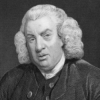
Samuel Johnson
Samuel Johnson, often referred to as Dr Johnson, was an English writer who made lasting contributions to English literature as a poet, essayist, moralist, literary critic, biographer, editor and lexicographer. Johnson was a devout Anglican and committed Tory, and has been described as "arguably the most distinguished man of letters in English history". He is also the subject of "the most famous single biographical work in the whole of literature," James Boswell's Life of Samuel Johnson...
NationalityEnglish
ProfessionNon-Fiction Author
Date of Birth18 September 1709
Solitude is the surest nurse of all prurient passions, and a girl in the hurry of preparation, or tumult of gaiety, has neither inclination nor leisure to let tender expressions soften or sink into her heart. The ball, the show, are not the dangerous places: no, 'tis the private friend, the kind consoler, the companion of the easy vacant hour, whose compliance with her opinions can flatter her vanity, and whose conversation can sooth, without ever stretching her mind, that is the lover to be feared: he who buzzes in her ear at court, or at the opera, must be contented to buzz in vain.
No wonder, Sir, that he is vain; a man who is perpetually flattered in every mode that can be conceived. So many bellows have blown the fire, that one wonders he is not by this time become a cinder.
The liberty of the press is a blessing when we are inclined to write against others, and a calamity when we find ourselves overborne by the multitude of our assailants.
The excellence of aphorisms consists not so much in the expression of some rare or abstruse sentiment, as in the comprehension of some useful truth in a few words.
Life cannot subsist in society but by reciprocal concessions.
Lichfield, England. Swallows certainly sleep all winter. A number of them conglobulate together, by flying round and round, and then all in a heap throw themselves under water, and lye in the bed of a river.
If a madman were to come into this room with a stick in his hand, no doubt we should pity the state of his mind; but our primary consideration would be to take care of ourselves. We should knock him down first, and pity him afterwards.
Players, Sir! I look on them as no better than creatures set upon tables and joint stools to make faces and produce laughter, like dancing dogs.
Ah! Sir, a boy's being flogged is not so severe as a man's having the hiss of the world against him.
Do not discourage your children from hoarding, if they have a taste to it; whoever lays up his penny rather than part with it for a cake, at least is not the slave of gross appetite; and shows besides a preference always to be esteemed, of the future to the present moment.
Religion informs us that misery and sin were produced together. The depravation of human will was followed by a disorder of the harmony of nature; and by that Providence which often places antidotes in the neighborhood of poisons, vice was checked by misery, lest it should swell to universal and unlimited dominion.
Misery and shame are nearly allied.
Frequent discontent must proceed from frequent hardships.
Men are most powerfully affected by those evils which themselves feel, or which appear before their own eyes.