Samuel Johnson
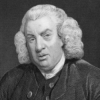
Samuel Johnson
Samuel Johnson, often referred to as Dr Johnson, was an English writer who made lasting contributions to English literature as a poet, essayist, moralist, literary critic, biographer, editor and lexicographer. Johnson was a devout Anglican and committed Tory, and has been described as "arguably the most distinguished man of letters in English history". He is also the subject of "the most famous single biographical work in the whole of literature," James Boswell's Life of Samuel Johnson...
NationalityEnglish
ProfessionNon-Fiction Author
Date of Birth18 September 1709
The misery of man proceeds not from any single crush of overwhelming evil, but from small vexations continually repeated.
Much mischief is done in the world with very little interest or design.
From all our observations we may collect with certainty, that misery is the lot of man, but cannot discover in what particular condition it will find most alleviations.
Misery is caused for the most part, not by a heavy crush of disaster, but by the corrosion of less visible evils, which canker enjoyment, and undermine security. The visit of an invader is necessarily rare, but domestic animosities allow no cessation.
All discourse of which others cannot partake is not only an irksome usurpation of the time devoted to pleasure and entertainment, but, what never fails to excite resentment, an insolent assertion of superiority, and a triumph over less enlightened understandings. The pedant is, therefore, not only heard with weariness but malignity; and those who conceive themselves insulted by his knowledge never fail to tell with acrimony how injudiciously it was exerted.
On Sir Joshua Reynolds's observing that the real character of a man was found out by his amusements. Yes, Sir, no man is a hypocrite in his pleasures.
The blaze of reputation cannot be blown out, but it often dies in the socket; a very few names may be considered as perpetual lamps that shine unconsumed.
To do nothing is in everyone's power.
To exact of every man who writes that he should say something new, would be to reduce authors to a small number; to oblige the most fertile genius to say only what is new, would be to contract his volumes to a few pages. Yet, surely, there ought to be some bounds to repetition; libraries ought no more to be heaped for ever with the same thoughts differently expressed, than with the same books differently decorated.
The complaint, therefore, that all topicks are preoccupied, is nothing more than the murmur of ignorance or idleness, by which some discourage others, and some themselves; the mutability of mankind will always furnish writers with new images, and the luxuriance of fancy may always embellish them with new decorations.
As not every instance of similitude can be considered as a proof of imitation, so not every imitation ought to be stigmatised as plagiarism. The adoption of a noble sentiment, or the insertion of a borrowed ornament, may sometimes display so much judgment as will almost compensate for invention; and an inferior genius may, without any imputation of servility, pursue the paths of the ancients, provided he declines to tread in their footsteps.
No writer can be fully convicted of imitation except there is a concurrence of more resemblance than can be imagined to have happened by chance; as where the same ideas are conjoined without any natural series or necessary coherence, or where not only the thought but the words are copied.
The authour who imitates his predecessors only by furnishing himself with thoughts and elegances out of the same general magazine of literature, can with little more propriety be reproached as a plagiary, than the architect can be censured as a mean copier of Angelo or Wren, because he digs his marble out of the same quarry, squares his stones by the same art, and unites them in columns of the same orders.
But though it cannot be reasonable not to gain happiness for fear of losing it, yet it must be confessed, that in proportion to the pleasure of possession, will be for some time our sorrow for the loss.