Samuel Johnson
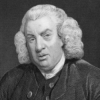
Samuel Johnson
Samuel Johnson, often referred to as Dr Johnson, was an English writer who made lasting contributions to English literature as a poet, essayist, moralist, literary critic, biographer, editor and lexicographer. Johnson was a devout Anglican and committed Tory, and has been described as "arguably the most distinguished man of letters in English history". He is also the subject of "the most famous single biographical work in the whole of literature," James Boswell's Life of Samuel Johnson...
NationalityEnglish
ProfessionNon-Fiction Author
Date of Birth18 September 1709
The great source of pleasure is variety.
The liberty of using harmless pleasure will not be disputed; but it is still to be examined what pleasures are harmless.
Nothing is more common than mutual dislike, where mutual approbation is particularly expected.
An infallible characteristic of meanness is cruelty. Men who have practiced tortures on animals without pity, relating them without shame, how can they still hold their heads among human beings?
It would add much to human happiness, if an art could be taught of forgetting all of which the remembrance is at once useless and afflictive, that the mind might perform its functions without encumbrance, and the past might no longer encroach upon the present.
Every government is perpetually degenerating towards corruption, from which it must be rescued at certain periods by the resuscitation of its first principles, and the re-establishment of its original constitution.
When a Man is tried of London, he is tired of life.
There is always something a woman will prefer to the truth.
Love has no great influences upon the sum of life.
That distrust which intrudes so often on your mind is a mode of melancholy, which, if it be the business of a wise man to be happy, it is foolish to indulge; and if it be a duty to preserve our faculties entire for their proper use, it is criminal. Suspicion is very often an useless pain.
Among those whose reputation is exhausted in a short time by its own luxuriance are the writers who take advantage of present incidents or characters which strongly interest the passions, and engage universal attention. It is not difficult to obtain readers, when we discuss a question which every one is desirous to understand, which is debated in every assembly, and has divided the nation into parties; or when we display the faults or virtues of him whose public conduct has made almost every man his enemy or his friend.
Some read for style, and some for argument: one has little care about the sentiment, he observes only how it is expressed; another regards not the conclusion, but is diligent to mark how it is inferred; they read for other purposes than the attainment of practical knowledge; and are no more likely to grow wise by an examination of a treatise of moral prudence, than an architect to inflame his devotion by considering attentively the proportions of a temple.
In most ages many countries have had part of their inhabitants in a state of slavery; yet it may be doubted whether slavery can ever be supposed the natural condition of man. It is impossible not to conceive that men in their original state were equal; and very difficult to imagine how one would be subjected to another but by violent compulsion. An individual may, indeed, forfeit his liberty by a crime; but he cannot by that crime forfeit the liberty of his children.
They whose activity of imagination is often shifting the scenes of expectation, are frequently subject to such sallies of caprice as make all their actions fortuitous, destroy the value of their friendship, obstruct the efficacy of their virtues, and set them below the meanest of those who persist in their resolutions, execute what they design, and perform what they have promised.