Samuel Johnson
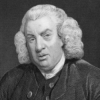
Samuel Johnson
Samuel Johnson, often referred to as Dr Johnson, was an English writer who made lasting contributions to English literature as a poet, essayist, moralist, literary critic, biographer, editor and lexicographer. Johnson was a devout Anglican and committed Tory, and has been described as "arguably the most distinguished man of letters in English history". He is also the subject of "the most famous single biographical work in the whole of literature," James Boswell's Life of Samuel Johnson...
NationalityEnglish
ProfessionNon-Fiction Author
Date of Birth18 September 1709
I have often thought that there has rarely passed a life of which a judicious and faithful narrative would not be useful; for not only every man has, in the mighty mass of the world, great numbers in the same condition with himself, to whom his mistakes and miscarriages, escapes and expedients, would be of immediate and apparent use; but there is such a uniformity in the state of man, considered apart from adventitious and separable decorations and disguises, that there is scarce any possibility of good or ill but is common to human kind.
Man is a transitory being, and his designs must partake of the imperfections of their author. To confer duration is not always in our power. We must snatch the present moment, and employ it well, without too much solicitude for the future, and content ourselves with reflecting that our part is performed. He that waits for an opportunity to do much at once, may breathe out his life in idle wishes, and regret, in the last hour, his useless intentions and barren zeal.
They make a rout about universal liberty, without considering that all that is to be valued, or indeed can be enjoyed by individuals, is private liberty.
They who most loudly clamour for liberty do not most liberally grant it.
He who has provoked the shaft of wit, cannot complain that he smarts from it.
Solitude is dangerous to reason, without being favorable to virtue. Remember that the solitary mortal is certainly luxurious, probably superstitious, and possibly mad.
Self-love is often rather arrogant than blind; it does not hide our faults from ourselves, but persuades us that they escape the notice of others.
It was his peculiar happiness that he scarcely ever found a stranger whom he did not leave a friend; but it must likewise be added, that he had not often a friend long without obliging him to become a stranger.
No degree of knowledge attainable by man is able to set him above the want of hourly assistance.
He is no wise man who will quit a certainty for an uncertainty.
It is very natural for young men to be vehement, acrimonious and severe. For as they seldom comprehend at once all the consequences of a position, or perceive the difficulties by which cooler and more experienced reasoners are restrained from confidence, they form their conclusions with great precipitance. Seeing nothing that can darken or embarrass the question, they expect to find their own opinion universally prevalent, and are inclined to impute uncertainty and hesitation to want of honesty, rather than of knowledge.
It is our first duty to serve society.
We all live in the hope of pleasing somebody; and the pleasure of pleasing ought to be greatest, and always will be greatest, when our endeavors are exerted in consequence of our duty.
He who endeavors to please must appear pleased.