Thomas Jefferson
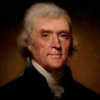
Thomas Jefferson
Thomas Jeffersonwas an American Founding Father who was the principal author of the Declaration of Independence. He was elected the second Vice President of the United States, serving under John Adams and in 1800 was elected the third President. Jefferson was a proponent of democracy, republicanism, and individual rights, which motivated American colonists to break from Great Britain and form a new nation. He produced formative documents and decisions at both the state and national level...
NationalityAmerican
ProfessionUS President
Date of Birth13 April 1743
CityShadwell, VA
CountryUnited States of America
Taxes should be proportioned to what may be annually spared by the individual.
It has also been a great solace to me, to believe that you are engaged in vindicating to posterity the course we have pursued for preserving to them, in all their purity, the blessings of self-government, which we had assisted too in acquiring for them. If ever the earth has beheld a system of administration conducted with a single and steadfast eye to the general interest and happiness of those committed to it, one which, protected by truth, can never know reproach, it is that to which our lives have been devoted.
The germ of dissolution of our federal government is in the constitution of the federal judiciary; an irresponsible body, (for impeachment is scarcely a scare-crow) working like gravity by night and by day, gaining a little today and a little tomorrow, and advancing its noiseless step like a thief, over the field of jurisdiction, until all shall be usurped from the States, and the government of all be consolidated into one.
The natural aristocracy I consider as the most precious gift of nature for the instruction, the trusts, and government of society. And indeed it would have been inconsistent in creation to have formed man for the social state, and not to have provided virtue and wisdom enough to manage the concerns of the society. May we not even say that that form of government is the best which provides the most - for a pure selection of these natural aristoi into the offices of government?
War is not the best engine for us to resort to; nature has given us one in our commerce, which if properly managed, will be a better instrument for obliging the interested nations of Europe to treat us with justice.
It is a wise rule and should be fundamental in a government disposed to cherish its credit, and at the same time to restrain the use of it within the limits of its faculties, "never to borrow a dollar without laying a tax in the same instant for paying the interest annually, and the principal within a given term; and to consider that tax as pledged to the creditors on the public faith."
We established however some, although not all its [self-government] important principles . The constitutions of most of our States assert, that all power is inherent in the people; that they may exercise it by themselves, in all cases to which they think themselves competent, (as in electing their functionaries executive and legislative, and deciding by a jury of themselves, in all judiciary cases in which any fact is involved,) or they may act by representatives, freely and equally chosen; that it is their right and duty to be at all times armed.
I join cordially in admiring and revering the Constitution of the United States, the result of the collected wisdom of our country. That wisdom has committed to us the important task of proving by example that a government, if organized in all its parts on the Representative principle unadulterated by the infusion of spurious elements, if founded, not in the fears & follies of man, but on his reason, on his sense of right, on the predominance of the social over his dissocial passions, may be so free as to restrain him in no moral right, and so firm as to protect him from every moral wrong.
The moral sense is as much a part of our constitution as that of feeling, seeing, or hearing.
With nations as with individuals our interests soundly calculated will ever be found inseparable from our moral duties.
Independence can be trusted nowhere but with the people in mass. They are inherently independent of all but moral law.
Responsibility is a tremendous engine in a free government.
Law is often the tyrant's will, and always so when it violates the right of an individual.
When, in the course of human events, it becomes necessary for one people to dissolve the political bands which have connected them with another, and to assume among the powers of the earth the separate and equal station to which the laws of nature and of nature's God entitle them, a decent respect to the opinions of mankind requires that they should declare the causes which impel them to the separation.