Thomas Jefferson
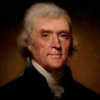
Thomas Jefferson
Thomas Jeffersonwas an American Founding Father who was the principal author of the Declaration of Independence. He was elected the second Vice President of the United States, serving under John Adams and in 1800 was elected the third President. Jefferson was a proponent of democracy, republicanism, and individual rights, which motivated American colonists to break from Great Britain and form a new nation. He produced formative documents and decisions at both the state and national level...
NationalityAmerican
ProfessionUS President
Date of Birth13 April 1743
CityShadwell, VA
CountryUnited States of America
The power of making war often prevents it, and in our case would give efficacy to our desire of peace.
Although our prospect is peace, our policy and purpose are to provide for defense by all those means to which our resources are competent.
[The people] are in truth the only legitimate proprietors of the soil and government.
Natural rights [are] the objects for the protection of which society is formed and municipal laws established.
But the fact being once established, that the press is impotent when it abandons itself to falsehood, I leave to others to restore it to its strength, by recalling it within the pale of truth. Within that, it is a noble institution, equally the friend of science and of civil liberty.
Enemies in War, in Peace Friends.
[A] spirit of justice and friendly accomodation...is our duty and our interest to cultivate with all nations.
We wish the happiness and prosperity of every nation.
I hope we shall prove how much happier for man the Quaker policy is, and that the life of the feeder is better than that of the fighter; and it is some consolation that the desolation by these maniacs of one part of the earth is the means of improving it in other parts. Let the latter be our office, and let us milk the cow, while the Russian holds her by the horns, and the Turk by the tail.
[I]t seems that the Cannibals of Europe are going to eat one another again. A war between Russia and Turkey is like the battle of the kite and snake; whichever destroys the other, leaves a destroyer the less for the world.
Still we did not expect to be without rubs and difficulties; and we have had them. First the detention of Western posts: then the coalition of Pilnitz, outlawing our commerce with France, and the British enforcement of the outlawry. In your day French depredations; in mine English, and the Berlin and Milan decrees: now the English orders of council, and the piracies they authorize. When these shall be over, it will the impressment of our seamen, or something else; and so we have gone on, and so we shall go on, puzzled and prospering beyond example in the history of man.
We are firmly convinced, and we act on that conviction, that with nations as with individuals our interests soundly calculated will ever be found inseparable from our moral duties, and history bears witness to the fact that a just nation is trusted on its word when recourse is had to armaments and wars to bridle others.
Still less, let it be proposed that our properties within our own territories shall be taxed or regulated by any power on earth but our own. The God who gave us life gave us liberty at the same time: the hand of force may destroy, but cannot disjoin them.
It must be observed that our revenues are raised almost wholly on imported goods.