Thomas Jefferson
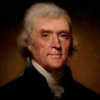
Thomas Jefferson
Thomas Jeffersonwas an American Founding Father who was the principal author of the Declaration of Independence. He was elected the second Vice President of the United States, serving under John Adams and in 1800 was elected the third President. Jefferson was a proponent of democracy, republicanism, and individual rights, which motivated American colonists to break from Great Britain and form a new nation. He produced formative documents and decisions at both the state and national level...
NationalityAmerican
ProfessionUS President
Date of Birth13 April 1743
CityShadwell, VA
CountryUnited States of America
A truth now and then projecting into the ocean of newspaper lies serves like headlands to correct our course. Indeed, my scepticism as to everything I see in a newspaper makes me indifferent whether I ever see one.
As for what is not true, you will always find abundance in the newspapers.
From forty years' experience of the wretched guess-work of the newspapers of what is not done in open daylight, and of their falsehood even as to that, I rarely think them worth reading, and almost never worth notice.
It is so difficult to draw a clear line of separation between the abuse and the wholesome use of the press, that as yet we have found it better to trust the public judgment, rather than the magistrate, with the discrimination between truth and falsehood. And hitherto the public judgment has performed that office with wonderful correctness.
Newspapers . . . serve as chimnies to carry off noxious vapors and smoke.
We lay it down as a fundamental, that laws, to be just, must give a reciprocation of right; that, without this, they are mere arbitrary rules of conduct, founded in force, and not in conscience.
The judiciary of the United States is the subtle corps of sappers and miners constantly working under ground to undermine the foundations of our confederated fabric. They are construing our constitution from a co-ordination of a general and special government to a general and supreme one alone.
One single object . . . [will merit] the endless gratitude of the society: that of restraining the judges from usurping legislation.
The Constitution on which our Union rests, shall be administered by me [as President] according to the safe and honest meaning contemplated by the plain understanding of the people of the United States at the time of its adoption - a meaning to be found in the explanations of those who advocated, not those who opposed it, and who opposed it merely lest the construction should be applied which they denounced as possible.
[T]he true key for the construction of everything doubtful in a law is the intention of the law-makers. This is most safely gathered from the words, but may be sought also in extraneous circumstances provided they do not contradict the express words of the law.
[The Federal Convention] is really an assembly of demigods.
The example of changing a constitution by assembling the wise men of the state, instead of assembling armies, will be worth as much to the world as the former examples we had give them. The constitution, too, which was the result of our deliberation, is unquestionably the wisest ever yet presented to men.
With earnest prayers to all my friends to cherish mutual good will, to promote harmony and conciliation, and above all things to let the love of our country soar above all minor passions, I tender you the assurance of my affectionate esteem and respect.
The power of making war often prevents it.