Thomas Jefferson
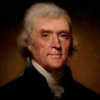
Thomas Jefferson
Thomas Jeffersonwas an American Founding Father who was the principal author of the Declaration of Independence. He was elected the second Vice President of the United States, serving under John Adams and in 1800 was elected the third President. Jefferson was a proponent of democracy, republicanism, and individual rights, which motivated American colonists to break from Great Britain and form a new nation. He produced formative documents and decisions at both the state and national level...
NationalityAmerican
ProfessionUS President
Date of Birth13 April 1743
CityShadwell, VA
CountryUnited States of America
We owe gratitude to France, justice to England, good will to all, and subservience to none ... it was by the sober sense of our citizens that we were safely and steadily conducted from monarchy to republicanism, and it is by the same agency alone we can be kept from falling back.
Our attachment to no nation on earth should supplant our attachment to liberty.
Convinced that the people are the only safe depositories of their own liberty, and that they are not safe unless enlightened to a certain degree, I have looked on our present state of liberty as a short-lived possession unless the mass of the people could be informed to a certain degree.
The functionaries of every government have propensities to command at will the liberty and property of their constituents. There is no safe deposit for these but with the people themselves, nor can they be safe with them without information. Where the press is free, and every man able to read, all is safe.
To all of which is added a selection from the elementary schools of subjects of the most promising genius, whose parents are too poor to give them further education, to be carried at the public expense through the college and university. The object is to bring into action that mass of talents which lies buried in poverty in every country, for want of the means of development, and thus give activity to a mass of mind, which, in proportion to our population, shall be double or treble of what it is in most countries.
Whensoever the General Government assumes undelegated powers, its acts are unauthoritative, void, and of no force.
No government can continue good but under the control of the people; and . . . . their minds are to be informed by education what is right and what wrong; to be encouraged in habits of virtue and to be deterred from those of vice . . . . These are the inculcations necessary to render the people a sure basis for the structure and order of government.
Honor, justice, and humanity, forbid us tamely to surrender that freedom which we received from our gallant ancestors, and which our innocent posterity have a right to receive from us.
[Oppose] with manly firmness [any] invasions on the rights of the people.
I think our governments will remain virtuous for many centuries as long as they are chiefly agricultural; and this will be as long as there shall be vacant lands in any part of America. When they get piled upon one another in large cities as in Europe, they will become corrupt as in Europe.
An elective despotism was not the government we fought for, but one which should not only be founded on true free principles, but in which the powers of government should be so divided and balanced among general bodies of magistracy, as that no one could transcend their legal limits without being effectually checked and restrained by the others.
I view great cities as pestilential to the morals, the health and the liberties of man. True, they nourish some of the elegant arts; but the useful ones can thrive elsewhere; and less perfection in the others, with more health, virtue and freedom, would be my choice.
The way to have good and safe government is not to trust it all to one, but to divide it among the many, distributing to everyone exactly the functions in which he is competent ... It is by dividing and subdividing these Republics from the great national one down through all its subordinations until it ends in the administration of everyman's farm by himself, by placing under everyone what his own eye may superintend, that all will be done for the best.
What country before ever existed a century and a half without a rebellion? And what country can preserve its liberties if their rulers are not warned from time to time that their people preserve the spirit of resistance? Let them take arms. The remedy is to set them right as to facts, pardon and pacify them. What signify a few lives lost in a century or two? The tree of liberty must be refreshed from time to time with the blood of patriots and tyrants. It is its natural manure.