Thomas Jefferson
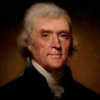
Thomas Jefferson
Thomas Jeffersonwas an American Founding Father who was the principal author of the Declaration of Independence. He was elected the second Vice President of the United States, serving under John Adams and in 1800 was elected the third President. Jefferson was a proponent of democracy, republicanism, and individual rights, which motivated American colonists to break from Great Britain and form a new nation. He produced formative documents and decisions at both the state and national level...
NationalityAmerican
ProfessionUS President
Date of Birth13 April 1743
CityShadwell, VA
CountryUnited States of America
A morsel of genuine history is a thing so rare as to be always valuable.
Were parties here divided merely by a greediness for office,...to take a part with either would be unworthy of a reasonable or moral man.
The whole art of government consists in the art of being honest.
Take not from the mouth of labor the bread it has earned.
Educate and inform the whole mass of the people. Enable them to see that it is their interest to preserve peace and order, and they will preserve them.
I prefer to be remembered for what I have done for others, not what others have done for me.
Subject opinion to coercion: whom will you make your inquisitors? Fallible men; men governed by bad passions, by private as well as public reasons. And why subject it to coercion? To produce uniformity. But is uniformity of opinion desirable? No more than of face and stature.
The issue today is the same as it has been throughout all history, whether man shall be allowed to govern himself or be ruled by a small elite.
I consider the government of the United States as interdicted by the Constitution from intermeddling with religious institutions, their doctrines, discipline, or exercises. This results not only from the provision that no law shall be made respecting the establishment or free exercise of religion, but from that also which reserves to the States the powers not delegated to the United States. Certainly, no power to prescribe any religious exercise or to assume authority in any religious discipline has been delegated to the General Government. It must then rest with the States.
The hocus-pocus phantasm of a God, like another Cerberus, with one body and three heads, had its birth and growth in the blood of thousands and thousands of martyrs.
Believing with you that religion is a matter which lies solely between man and his God, that he owes account to none other for his faith or his worship, that the legislative powers of government reach actions only, and not opinions, I contemplate with sovereign reverence that act of the whole American people which declared that their legislature should 'make no law respecting an establishment of religion, or prohibiting the free exercise thereof,' thus building a wall of separation between church and State.
To talk of immaterial existences is to talk of nothings. To say that the human soul, angels, god, are immaterial, is to say they are nothings, or that there is no god, no angels, no soul. I cannot reason otherwise: but I believe I am supported in my creed of materialism by Locke, Tracy, and Stewart. At what age of the Christian church this heresy of immaterialism, this masked atheism, crept in, I do not know. But heresy it certainly is.
The clergy ... believe that any portion of power confided to me [as President] will be exerted in opposition to their schemes. And they believe rightly: for I have sworn upon the altar of God, eternal hostility against every form of tyranny over the mind of man. But this is all they have to fear from me: and enough, too, in their opinion.
Nature intended me for the tranquil pursuits of science, by rendering them my supreme delight. But the enormities of the times in which I have lived, have forced me to take a part in resisting them, and to commit myself on the boisterous ocean of political passions.