William James
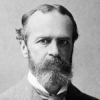
William James
William Jameswas an American philosopher and psychologist who was also trained as a physician. The first educator to offer a psychology course in the United States, James was one of the leading thinkers of the late nineteenth century and is believed by many to be one of the most influential philosophers the United States has ever produced, while others have labelled him the "Father of American psychology". Along with Charles Sanders Peirce and John Dewey, he is considered to be...
NationalityAmerican
ProfessionPhilosopher
Date of Birth11 January 1842
CityNew York City, NY
CountryUnited States of America
Results should not be too voluntarily aimed at or too busily thought of. They are sure to float up of their own accord from a long enough daily work at a given matter.
The greatest empiricists among us are only empiricists on reflection: when left to their instincts, they dogmatize like infallible popes.
However inadequate our ideas of causal efficacy may be, we are less wide of the mark when we say that our ideas and feelings have it, than the Automatists are when they say they haven't it. As in the night all cats are gray, so in the darkness of metaphysical criticism all causes are obscure. But one has no right to pull the pall over the psychic half of the subject only . . . whilst in the same breath one dogmatizes about material causation as if Hume, Kant, and Lotze had never been born.
The simplest rudiment of mystical experience would seem to be that deepened sense of the significance of a maxim or formula which occasionally sweeps over one.
The highest flights of charity, devotion, trust, patience, bravery to which the wings of human nature have spread themselves, have been flown for religious ideals.
The ultimate test of what a truth means is the conduct it dictates or inspires.
Of all the beautiful truths pertaining to the soul None is more gladdening or fruitful than to know You can regenerate and make yourself what you will.
In order to disprove the assertion that all crows are black, one white crow is sufficient.
[There are, in us] possibilities that take our breath away, and show a world wider than either physics or philistine ethics can imagine. Here is a world in which all is well, in spite of certain forms of death, death of hope, death of strength, death of responsibility, of fear and wrong, death of everything that paganism, naturalism and legalism pin their trust on.
The word 'cause' is an altar to an unknown god.
The stream of thought flows on; but most of its segments fall into the bottomless abyss of oblivion. Of some, no memory survives the instant of their passage. Of others, it is confined to a few moments, hours or days. Others, again, leave vestiges which are indestructible, and by means of which they may be recalled as long as life endures.
The most immutable barrier in nature is between one man's thoughts and another's.
You can alter your life by altering the state of your mind.
The true is the name of whatever proves itself to be good in the way of belief, and good, too, for definite, assignable reasons.