Aristotle
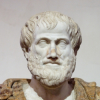
Aristotle
Aristotle was a Greek philosopher and scientist born in the city of Stagira, Chalkidice, on the northern periphery of Classical Greece. His father, Nicomachus, died when Aristotle was a child, whereafter Proxenus of Atarneus became his guardian. At eighteen, he joined Plato's Academy in Athens and remained there until the age of thirty-seven. His writings cover many subjects – including physics, biology, zoology, metaphysics, logic, ethics, aesthetics, poetry, theater, music, rhetoric, linguistics, politics and government – and constitute the first comprehensive system...
NationalityGreek
ProfessionPhilosopher
The man with a host of friends who slaps on the back everybody he meets is regarded as the friend of nobody.
A proper wife should be as obedient as a slave... The female is a female by virtue of a certain lack of qualities - a natural defectiveness.
Teaching is the highest form of understanding.
Personal beauty is a greater recommendation than any letter of reference.
He is his own best friend and takes delight in privacy whereas the man of no virtue or ability is his own worst enemy and is afraid of solitude.
The ultimate value of life depends upon awareness and the power of contemplation rather than upon mere survival.
The most perfect political community is one in which the middle class is in control, and outnumbers both of the other classes.
The activity of happiness must occupy an entire lifetime; for one swallow does not a summer make.
Prayers and sacrifices are of no avail.
The tyrant, who in order to hold his power, suppresses every superiority, does away with good men, forbids education and light, controls every movement of the citizens and, keeping them under a perpetual servitude, wants them to grow accustomed to baseness and cowardice, has his spies everywhere to listen to what is said in the meetings, and spreads dissension and calumny among the citizens and impoverishes them, is obliged to make war in order to keep his subjects occupied and impose on them permanent need of a chief.
Where it is in our power to act, it is also in our power to not act.
We cannot ... prove geometrical truths by arithmetic.
The law is reason unaffected by desire.
For just as for a flute-player, a sculptor, or an artist, and, in general, for all things that have a function or activity, the good and the well is thought to reside in the function, so would it seem to be for man, if he has a function.