Aristotle
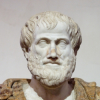
Aristotle
Aristotle was a Greek philosopher and scientist born in the city of Stagira, Chalkidice, on the northern periphery of Classical Greece. His father, Nicomachus, died when Aristotle was a child, whereafter Proxenus of Atarneus became his guardian. At eighteen, he joined Plato's Academy in Athens and remained there until the age of thirty-seven. His writings cover many subjects – including physics, biology, zoology, metaphysics, logic, ethics, aesthetics, poetry, theater, music, rhetoric, linguistics, politics and government – and constitute the first comprehensive system...
NationalityGreek
ProfessionPhilosopher
It is in justice that the ordering of society is centered.
To be ignorant of motion is to be ignorant of nature
Laughter is a bodily exercise, precious to Health
The greatest threat to the state is not faction but distraction
Cruel is the strife of brothers.
Philosophy begins with wonder.
What is common to many is least taken care of, for all men have greater regard for what is their own than what they possess in common with others.
Good has two meanings: it means that which is good absolutely and that which is good for somebody.
It was through the feeling of wonder that men now and at first began to philosophize.
The actuality of thought is life.
It concerns us to know the purposes we seek in life, for then, like archers aiming at a definite mark, we shall be more likely to attain what we want.
Thus it is thought that justice is equality; and so it is, but not for all persons, only for those that are equal. Inequality also is thought to be just; and so it is, but not for all, only for the unequal. We make bad mistakes if we neglect this for whom when we are deciding what is just. The reason is that we are making judgements about ourselves, and people are generally bad judges where their own interests are involved.
A tragedy is the imitation of an action that is serious and also, as having magnitude, complete in itself . . . with incidents arousing pity and fear, wherewith to accomplish its catharsis of such emotions.
Thus every action must be due to one or other of seven causes: chance, nature, compulsion, habit, reasoning, anger, or appetite.