John Maynard Keynes
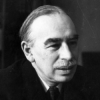
John Maynard Keynes
John Maynard Keynes, 1st Baron Keynes, CB, FBA, was an English economist whose ideas fundamentally changed the theory and practice of macroeconomics and the economic policies of governments. He built on and greatly refined earlier work on the causes of business cycles, and is widely considered to be one of the most influential economists of the 20th century and the founder of modern macroeconomics. His ideas are the basis for the school of thought known as Keynesian economics and its...
NationalityEnglish
ProfessionEconomist
Date of Birth5 June 1883
When my information changes, I alter my conclusions. What do you do, sir?
Markets can remain irrational longer than you can remain solvent.
If you owe your bank a hundred pounds, you have a problem. But if you owe a million, it has.
Worldly wisdom teaches that it is better for reputation to fail conventionally than to succeed unconventionally.
It is ideas, not vested interests, which are dangerous for good or evil.
There is nothing so disastrous as a rational investment policy in an irrational world.
Canada is a place of infinite promise. We like the people, and if one ever had to emigrate, this would be the destination, not the U.S.A. The hills, lakes and forests make it a place of peace and repose of the mind, such as one never finds in the U.S.A.
Once doubt begins it spreads rapidly.
Successful investing is anticipating the anticipations of others.
Everything is always decided for reasons other than the real merits of the case
The classical theorists resemble Euclidean geometers in a non-Euclidean world who, discovering that in experience straight lines apparently parallel often meet, rebuke the lines for not keeping straight as the only remedy for the unfortunate collisions which are occurring. Yet, in truth, there is no remedy except to throw over the axiom of parallels and to work out a non-Euclidean geometry.
The master-economist must possess a rare combination of gifts. He must reach a high standard in several different directions and must combine talents not often found together. He must be mathematician, historian, statesman, philosopher - in some degree. He must understand symbols and speak in words. He must contemplate the particular in terms of the general, and touch abstract and concrete in the same flight of thought. He must study the present in the light ofthe past for the purposes of the future
As time goes on, I get more and more convinced that the right method in investment is to put fairly large sums into enterprises which one thinks one knows something about and in the management of which one thoroughly believes. It is a mistake to think that one limits one's risk by spreading too much between enterprises about which one knows little and has no reason for special confidence. . . . One's knowledge and experience are definitely limited and there are seldom more than two or three enterprises at any given time in which I personally feel myself entitled to put full confidence.
Perhaps it is historically true that no order of society ever perishes save by its own hand.